Posts

Mirror Bearer - Mayan Art
Image
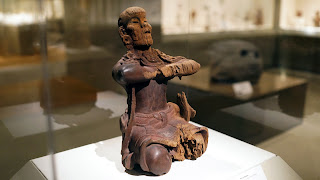
The Maya Galleries in the Metropolitan Museum of Art is home to one of the rarest Mayan figures ever excavated from Mesoamerica. The "Mirror Bearer" is a small figurine crafted from wood and it dates back to the 6th century. This figurine is in incredible condition considering there are not many wooden pieces that have survived the humidity of South America. This wooden figure has drawn a lot of interest because of its posture. The figure is kneeling, with its arms crossed and fists pushed into the chest. This is said to indicate that this person was holding a mirror, specifically pointed at the ruler. When we think mirror, we think flat glass surface but in the case of ancient Mayan civilizations the reflective surface they referred to as mirrors were actually obsidian or pyrite stones fashioned in a mosaic. The mirror holder and mirrors specifically have a large symbolic meaning to the Mayans. Holding a mirror to the king is a way to reflect his divinity and royalty. The...

Mesa Verde

Image
 The Mesa Verde National Park, located in the south western slope of Colorado near Grand Junction, was created in 1906 and is said to be the largest archeological site in the United States as well as one of the largest in the world.  Beginning around 1000 C.E, the Ancestral Puebloan peoples built and created over 600 structures into the cliff faces as Mesa Verde. These structures were built using natural materials such as stone, mortar, plaster and mud. The completed structures were mainly used as homes and residences but there were also cases of these structures being used for storage or for ritual purposes.  Kiva "Spruce Tree House" located at Mesa Verde One of the largest and most famous cave dwelling located in Mesa Verde is the Cliff Palace. The Cliff Palace is so large it is said to contain over 120 individual rooms as well as 20+ larger circular rooms. These buildings ranged from 1-4 stories tall and some of them even reached the ceiling of the rocks containing the...

The Paracas Textile

Image
              The Paracas Textile, woven from cotton and camelid fiber, discovered in southern Peru A Textile is a type of cloth or woven fabric. One of the most incredible textiles of pre-Columbian America is the Paracas Textile. Dating back to nearly 2,000 years ago, the Paracas Textile comes from the south coast, Paracas, Peru. The Paracas Textile measures two by five feet. Despite this textile being relatively small in size, it is said to contain a vast amount of information about the people who lived in ancient Peru.  The Paracas Textile is currently a part of a collection at the Brooklyn Museum of Art and has been since 1938. Despite the age and delicacy of the textile it is said to still show vibrant colors and all of the fine details are still perfectly intact. They say that the arid climate in southern Peru is so dry, any organic materials that may be buried there can actually be preserved.              ...

Butcher Boys

Image
 Dr. Amy Nygaard Mickelson, "Jane Alexander,  Butcher Boys ," in  Smarthistory , September 29, 2020, accessed November 3, 2020,  https://smarthistory.org/jane-alexander-butcher-boys/ .   In 1985 and 86' while still a graduate student at the University of Witwatersrand in Johannesburg, South African artist Jane Alexander created the life-sized sculpture titled Butcher Boys. This piece of art work consists of three "monstrous" figures sitting casually on a wooden bench. These figures were composed of reinforced plaster, animal bones, horns, oil paint, and of course the wooden bench they sit atop. Many observations of the piece lead to the same questions; are the figures man or beast? And what do they represent? Butcher Boys on display at South African National Gallery in Cape Town The artist Alexander goes on to explain how Butcher Boys causes discomfort in its viewers because their form comes very close to ours as humans, but their anatomy contains many non human...

Lydenburg Heads

Image
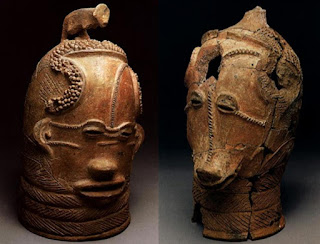
  Department of the Arts of Africa, Oceania, and the Americas. “Lydenburg Heads (ca. 500 A.D.).” In  Heilbrunn Timeline of Art History . New York: The Metropolitan Museum of Art, 2000–. http://www.metmuseum.org/toah/hd/lyde/hd_lyde.htm (October 2000) The topic I decided to write about this week is the Lydenburg Heads of Lydenburg, South Africa. The Lydenburg Heads is a set of 7 separate terracotta heads that were discovered in the Eastern part of South Africa, The oldest head is thought to be from around 500 A.D. and the others are thought to be from the same time period because of similarities and details between all of the heads.    Left: one of the "near life sized" heads could be worn over the head. Right: one of the smaller Lydenburg heads. The long snout can be representative of a significant animal or creature. The Lydenburg Heads are actually the earliest known examples of Iron Age art south of the equator and because of this, the heads are considered a ...

Aksumite Coins

Image
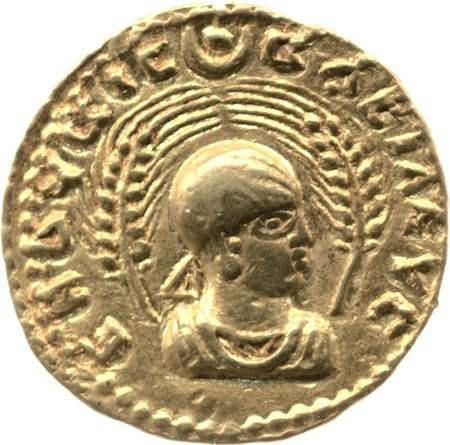
 https://smarthistory.org/aksumite-coins/     Coins are uniquely significant and give us a greater insight into the history of Aksum. These coins are said to be significant not only because they provided evidence of a form of currency in Aksum but also because they depicted its rulers. The way these coins were inscribed has given us insight into the fact that Aksumites were both knowledgeable and literate people.       Early indicators suggested the main use of these coins was for trade internationally. The earliest coins were struck in gold and silver and followed weight standards established by the Roman Empire. These coins represented King Endybis (c. 270-290 C.E.) and symbols such as the crescent and disc were said to represent the religion of southern Arabia, to which Aksuma was accustomed to.  Aksumite gold coin. Bust represents King Endubis, triangular ribbon behind, wrapped in wheat. King Ezana took power in 340 C.E and brought along Chris...

Pottery and Clay FIgures - Jomon Period

Image
 https://smarthistory.org/japan-jomon-heian/      The Jomon period, between c.10,500 - c. 300 B.C.E, was Japan's Neolithic Period. The term neolithic is most commonly used in connection with agriculture and this is the case because during this time period many people obtained food by gathering, fishing, and hunting. It was also during this time period that the concept of crop cutivation and animal domestication was introduced.Similar to many other Neolithic cultures around the world, it was the women who were responsible for the earliest pottery and works of art with clay.  "Flame-rimmed" deep bowl from middle Jomon Period     This pottery was constructed from the bottom up using coils of wet clay mized with other natural materials suchs as mica or even seashells. From there, the pots are smoothed, both inside and out, using unique geometric patterns for decoration. Many of these decorations were achieved by pressing rope or cord against the still wet,...

"The Temple of Flourishing Law" - Asuka Period

Image
https://smarthistory.org/japan-jomon-heian/      The Asuka period was Japan's first historical period. What made the Asuka period different from previous prehistoric periods (Jomon period, Yayoi period, and Kofun period.) was the introduction of writing from China and Korea. The introduction of written language was extremely influential on this time period because it introduced not only writing, but also a standardized measuring system, a new currency in the form of coins, and the practice of historical record keeping. Eventually, these things would lead to the creation of a centralized and bureaucratic government modeled after the Chinese.      The Asuka period was also the time when Buddhism was introduced to Japan. This would significantly change Japanese culture and society because it differed from the traditional, indigenous religion of Japan, Shinto or "way of the gods". Shinto is a relatinship with nature that represent important spirits with shrines...

The Stupa

Image
https://smarthistory.org/the-stupa/     The stupa looks like a hemisphere or semi-circle and it is meant to represent the burial mound of the Buddha (founder of Buddhism) and a resting place for his relics. Some stupas also held the relics of other great Buddhist teachers and important monks. Interestingly enough, a stupa can also take the form of a small container or reliquary. These stupas were made to contain the ashes of a person, very similar to what we know today as a urn.    The Great Stupa, located near the village of Sanchi in India was constructed nearly two thousand years ago. More recently though there have been additions to the exterior, four gateways were added that mark cardinal direction. The Great Stupa's exterior is undecorated , but the gateways are carved with elaborate scenes, figures, and narratives. While these gateways contain so many narratives, Buddha is never once depicted in human form but it is said that he is represented by various ...

Angkor Wat

Image
https://smarthistory.org/angkor-wat/      Angkor Wat is a grand temple located in Siem Reap, Cambodia. Angkor Wat, when translated from Khmer (the official language of Cambodia) means "city temple" and is the largest religious monument in the world.       Angkor Wat has a lot of history and religious meaning. The Hindu religion has three principal gods in the Hindu pantheon; Shiva, Brahma, and Vishnu. The temple is said to be dedicated to the Hindu God Vishnu, also known as the "Protector". Angkor Wat began construction in 1113 C.E. and was built by King Suryavarman II. The king, whos name translates to "protector of the sun" was thought to be laid to rest here after death, meaning the temple was not only the home of the Hindu God Vishnu, but also the mausoleum of King Suryavarman II.       Khmer kings often had to legitimize their claim to political office by building temples. This was also a way to claim the protection and powers ...

Art of the Viking Age

Image
https://smarthistory.org/viking-art/ Vikings, contrary to the way they are depicted in modern film, belonged to a group of peoples called the Norse who were merchants, farmers, and craftsmen. The Viking Age which took place from 8th century to 11th century led people from Denmark, Norway, and Sweden to sail the globe.  Visuals were of great importance to the Norse. Objects were created from highly-skilled craftspeople such as woodworks and blacksmiths. Materials such as metal, stone, ivory, and even bone have been recovered from pieces of Norse art.  Many Norse objects were created with both practical and symbolic purposes. Imagery in the art was created to communicate ideas about social religions, religious beliefs, and even to tell mythical tales.  Viking art is distinct from other cultures as it represents a unique way of thinking about the world.  The pictures about show carvings of the stern of Oseberg's ship. Each section of the stern is carved in a unique styl...

The Bestiary; Book of Beats in the Medieval World

Image
      The Bestiary  https://smarthistory.org/bestiary-book-beasts-medieval-world/     The middle ages is a period of time in Europe between the end of the fifth century and the start of the Renaissance in the fifteenth century. This time period has been famously referred to as the dark ages due to the loss of classical learning after antiquity in the fifth century. Contrary to belief, the dark ages was not a time of struggle or ignorance. As historians learned more about the time period, they changed the name to the middle ages and this was a time when Christianity was flourishing in Europe.                            The Bestiary was one of the most popular texts during the middle ages all due to the mass expansion of Christianity in Europe. Followers of Christianity believed that every element of the world is a creation/manifestation of God. This book places emphasis on the religio...

Mosque Architecture

Image
https://smarthistory.org/introduction-to-mosque-architecture/ A mosque is a building or place where Muslims gather for prayer. Like the church to Christianity, the mosque is a very important part of the Islam religion. The original mosque was thought to be the home of the Prophet Muhammad. His home was constructed in the "7th-century Arabian style, with a large courtyard, surrounded by rooms supported by columns". As a result many of the mosques is this area are designed in this same style. Islam is a global religion, its followers spread across the world. The followers of Islam have constructed Mosques all over the world many with different designs and representations. Due to the common function of the mosque, they do share common features. Every mosque, regardless of the time it was built and the region it was built in shares four common features; a courtyard (Sahn), a niche (Mihrab), a tower (minaret), and a dome (qubba). The courtyard is the place where all men in the tow...

Mecca and The Kaaba

Image
 Islam is one of the world's monotheistic faiths. The Kaaba, believed to have been built by Abraham and his son Ishmael is the most important center for pilgrimage in Islam.  The Kaaba, which means 'cube' in Arabic, is the religious epicenter of Mecca. The Kaaba is granite masonry covered in silk curtain, with calligraphy in gold and silver thread. It is the holiest shrine in Islam. In the Islam religion, followers pray five times a day, and regardless of your location, these prayers are directed towards Mecca and the Kaaba.  The Pre-Islamic Kaaba originally housed the black stones and statues of Pagan gods. Muhammad was the one who returned the shrine to the monotheism of Abraham. The black stone of the Kaaba is highly revered by the Muslims because it is believed to have been given the Abraham by the Angel Gabriel.  Hajj is the pilgrimage to Mecca, this is a religious event that almost every Islam strives to achieve in their lifetime. Hajj is one of The Five Pillar...

Ludovisi Battle Sarcophagus

Image
https://smarthistory.org/battle-of-the-romans-and-barbarians-ludovisi-battle-sarcophagus/ Ancient Rome has a very rich history. My first thought about Ancient Rome revolves around the idea of gladiators, fighting for sport and entertainment at The Colosseum. As I dove farther into research I stumbled across the Ludovisi Battle Sarcophagus.  This large stone impression is a depiction of the fighting between the Romans and the Barbarians (goths). This large piece contains over 50 individual figures made with incredible detail. As we examine the piece closer, we are easily able to identify the Romans and tell them apart from the goths. The Romans are depicted as "good guys" in the impression they are shown are more noble and honorable, dressed in armor, their features are more detailed and ideal. This was made to symbolize the Romans as noble and brave men compared to the savage barbarians. The Barbarians are far less detailed, described as caricature like compared to the Romans...

Greek Architectural Orders

Image
https://smarthistory.org/greek-architectural-orders/ Architecture in ancient Greece was extremely advanced for its time. Famous buildings such as The Parthenon and The Acropolis are some of the earliest examples of modern day architecture that we can find.  An Architectural Order describes a style of building. The most classical Greek Architectural Orders are; Doric, Ionic, and Corinthian.  The Doric Order is one of the earliest forms of pillar to date. " The Doric order emerged on the Greek mainland during the course of the late seventh century B.C.E. and remained the predominant order for Greek temple construction through the early fifth century B.C.E., although notable buildings of the Classical period—especially the canonical Parthenon in Athens—still employ it."  The Ionic Order, while emerging around the same time, was built slightly different with the base supporting the column unlike the Doric Order. " The monumental temple dedicated to Hera on the island of Samo...

The Lion Gate, Mycenae

Image
The Lion Gate https://smarthistory.org/lion-gate-mycenae/  The Mycenaean culture dominated southern Greece from 1600 B.C.E. to 1100 B.C.E. around the time of the Bronze Era in Greece. The Mycenaean Period also referred to as the "age of heroes" was a time well known for Homer's Epics, tales of Greek Mythology that we are familiar with even today. The culture made famous by stories, also contributed some of the earliest metal workings, large-scale construction, and readable writings ever discovered by historians.    Mycenae, in Southern Greece was seen as a fortress on a hill, not only because of its geographical location, but due to its sheer size. In Homer's Epics there is a story of the cyclops, a giant, one-eyed race of mythical creatures. It is said that the stones used to build The Citadel are so large, that only the Cyclops is capable of moving stones that size. Within this fortress lies The Lion Gate. As you can see in the picture, The Lion Gate is a large impr...

Ashurbanipal Hunting Lions

Image
I have selected art out of the Assyrian Empire and more specifically, the piece I chose is Ashurbanipal Hunting Lions. ( https://smarthistory.org/ashurbanipal-hunting-lions/ ) After researching, the artwork I've decided to highlight today is Ashurbanipal Hunting Lions. The Assyrian Empire had a large military culture. Men were obligated to fight in the army and serve under the aggressive warrior king. The Assyrians were savages, their armies would kill, conquer, and burn entire villages. Resources were collected from these conquests and as a result, Assyrian Kings were incredibly wealthy. The kings used their riches to build large, luxurious palaces. On the inside, these palaces were decorated  with grand impressions depicting warriors, war and fighting. The warriors in these impressions were all depictions of the Assyrian King as a grand warrior.  Ashurbanipal Hunting Lions is especially interesting because of the symbolism that the impression portrays. This impression is sai...
Image
 Hello All, my name is Jeremy Velasco. I am currently a senior a CSU- Pueblo working on my final semester of college. By Christmas I will be graduating with a degree in Business Administration! In the future, I plan on using my degree to assist my family in their construction management business. I have always been fascinated with architecture, especially historical buildings, monuments, and large works of art.   While looking over the smart history website, I was immediately drawn to Asia. All across the continent, you can find buildings, statues and works of art over thousands of years old. Diving in a bit further, I could not take my eyes off of Rajarajesvara Temple. The amount of detail brought to life at this scale is incredible to me. Think about how this was done in the Eleventh Century C.E. with little technology, and few tools to get this type of result. I am so interested in knowing the process and execution in creating something like this. https://smarthistory....